People experience something before they comprehend what you are saying. Relaxation, anxiety, or friendliness or excitement come before information and rationale. This emotional cut is the reason why certain content is magnetic, and other content is forgettable despite the strong message.
It is around this reality that Pippit is constructed. It does not consider backgrounds as decoration but as emotional instruments. Pippit is a video agent who works smartly to bring intention to the atmosphere. The outcome is content that does not simply communicate, but goes deeper.
Places are mute narrators.
Both stories are told even with or without planning. The neutral and soft environment is a sign of safety and trust. The large, contrasted space is a sign of urgency and action. Nostalgia, excitement, or contemplation take place without any words being uttered due to seasonal cues. Storytelling is incomplete when creators do not consider this layer. Content is immersive when they create it on purpose. Backgrounds no longer remain passive images and begin to lead through the emotional flow of viewers.
Deliberate mood manipulation alters the way the viewers associate.
Reactive content adheres to trends. Experiences are developed by strategic content. When creators decide the experience content ought to have before publication, they have an influence over perception. The announcement should be inspirational rather than pushy. Sales messages need not have a pushy feeling but rather a confident one. A learning video would be relaxing rather than intimidating. Creating a background with the help of AI background generators allows creators to modify emotional context without altering the very message.
Campaigns work when feelings and images move in the same direction.
Powerful campaigns are emotionally united. There is a unity of vision, time and tone. Backgrounds serve as major reinforcements towards that direction.
Mindfulness campaign has the advantages of soft materials and natural illumination. Limited-time offers work better in competitive, focused markets. An autobiographical narrative resonates more in intimate, close-up places. When the surroundings are favourable to the purpose, the message is received in a clearer and more impactful manner.
Reducing emotional strategy to images with pippit.
Knowing mood is one thing, but the implementation is something most creators have a hard time with. Pippit eliminates that friction by ensuring that AI-generated backgrounds are made fast, interactive, and practical with daily work processes. Three steps are used to follow the process.
Step 1: Post photos without interrupting the creative flow.
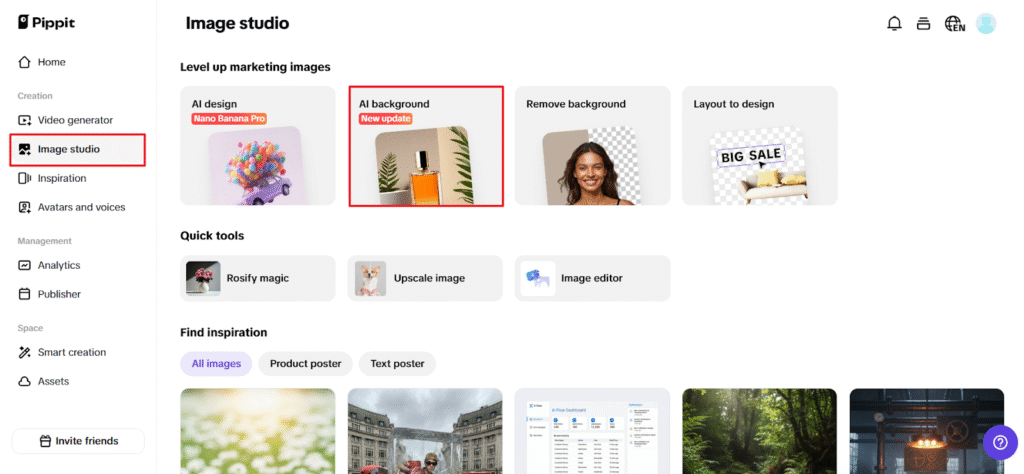
Start by registering Pippit and opening Image Studio in the left sidebar. The background of AI was selected under Quick Tools. You are able to drag and drop your product images, import them using your device or use links to upload them. This capacity enables developers to switch fast between the idea and the product.
Step 2: Personalise image background and content.
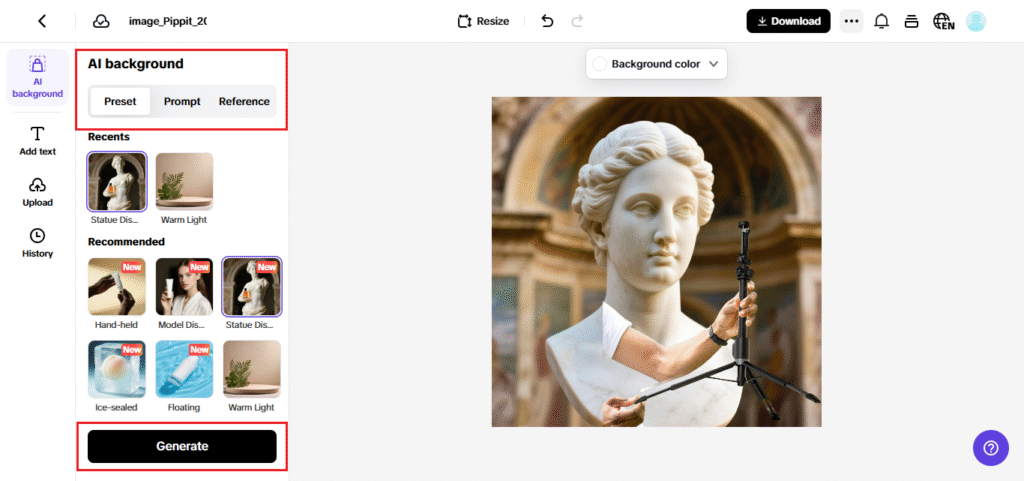
The background that exists is immediately deleted as soon as it is uploaded. Selection of a preset background, an uploaded reference image, or a newly generated scene can be done here with prompts. There is also an option to add text overlays or turn the image into a sales poster. This is a procedure that coordinates mood, message, and branding under a single frame.
Step 3: Ship visuals that are prepared to tell a story (emotions).
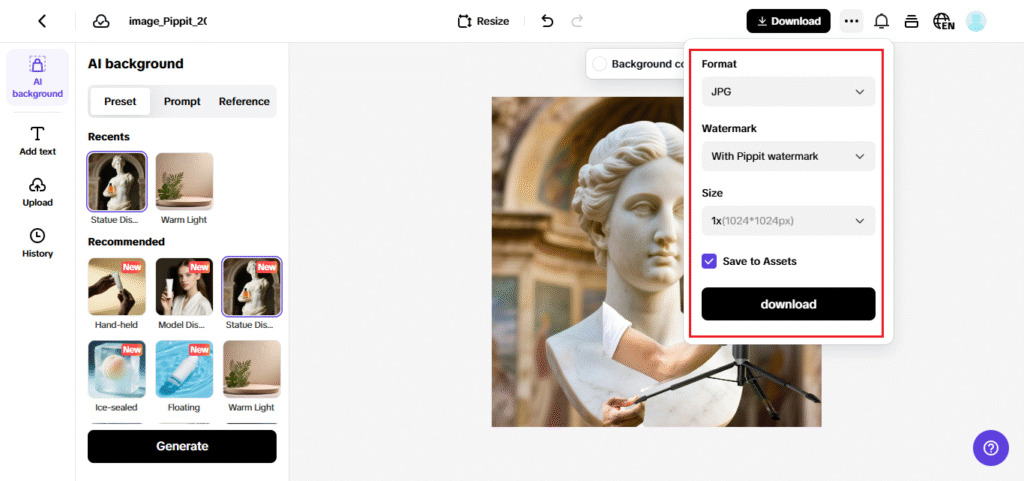
Once more, after making the necessary adjustments, press the Download button in the upper right corner. Choose file format as well as size depending on your platform requirements. You have the option of exporting the image with or without a watermark and crossing the border, having it prepared for a campaign, a post or even a promotion.
Why content motivated by mood works better than more aggressive strategies.
Interesting content can be used to stop the scroll, but congruent content can be used to retain attention. With the right message and right mood, viewers get the feeling that they, but not they, are being sold something. Emotional comfort enhances watch time, performance, and trust in both the short and long-term. Artists who design moodily find loyalty to the audience to be greater. Individuals do not merely come back to get information, but they go back to see how the content will make them feel.
Change of seasons, but your content system should not fail.
New shoots, new locations and new costs were traditionally associated with matching seasons or campaigns. This rendered emotional storytelling tedious. Nowadays, filming and styling are separated by the creators. Among the tools that work similarly to a Free AI video editor, creators record and edit later after capturing the video. This enables the content to be shared across seasons, platforms, and moods without continual reshoots. Effectiveness is enhanced, and innovation remains open-minded.
The latest creative advantage is emotional flexibility.
Creators have control over the mood without having to refill. A single idea may be in a variety of emotional situations. The visual in one campaign may be developed over time. A single brand can experience uniformity even when the seasons are shifting. This variability will minimise burnout and instil confidence. There is no longer a physical space that you are confined by. You have been led by emotional purpose.
Conclusion: Do design emotion knowingly with Pippit.
Mood is not an incident in contemporary storytelling. It’s a strategic choice. Pippet gives creators the capability to influence emotion on purpose, matching images with seasons, campaigns, and objectives with no additional complexity.
When you prefer your work to sound consistent, emotionally smart, and flexible without re-editing it all the time, Pippit provides you with such freedom. Create the atmosphere, lead the narrative and make your images speak better than you.

