Introduction
For engineers and procurement heads looking to procure sophisticated and precise parts, the selection of the right 5-Axis CNC Machining Supplier is a matter of utmost importance. While conventional means of supplier selection, such as website checks, quality certifications, and quotes, are often superficial and do not reflect the true capabilities, quality culture, and discipline of the supplier, the consequences of incorrect selection are often seen in project delays, cost overruns, and quality surprises, thereby compromising the entire partnership.
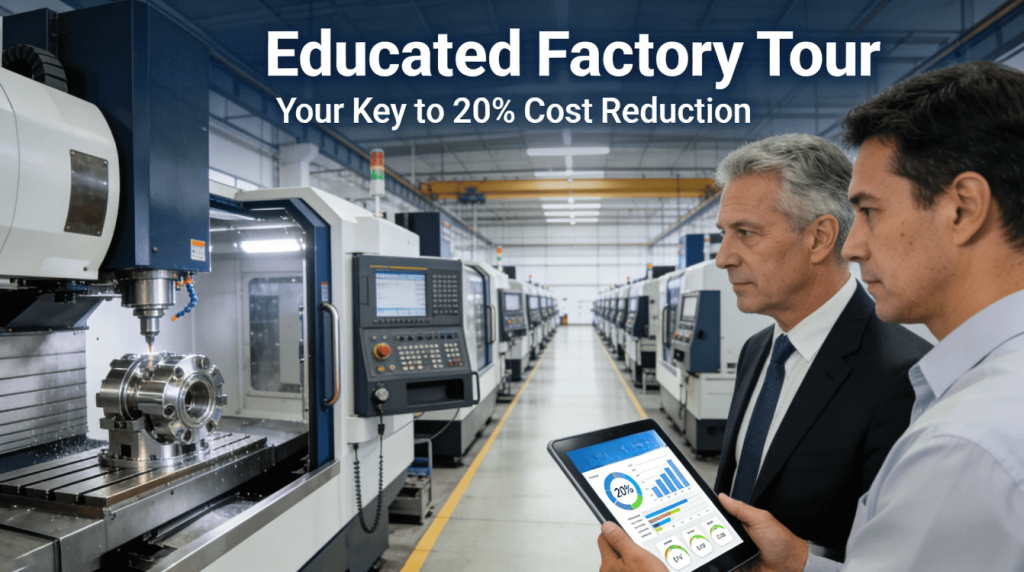
The key issue here is the lack of information. While the key drivers for providing quotes, such as machine performance stability, programming strategy optimization, and process discipline, are difficult to quantify and document, many people overlook the importance of the factory visit as part of the supplier selection process. In this article, we redefine the term “factory tour” and transform it from being a mere ceremonial activity to being a key supplier selection tool, providing insights on what to look out for, ask, and verify during the Industrial Tour to convert it into quantifiable risk reduction and cost saving.
Beyond the Brochure: Why is a Technical Workshop Visit Critical Before Placing Your Complex Part Order?
While a supplier’s documentation, such as certificates, lists of machines, and glossy brochures, presents a prepared story, a technical workshop visit presents you with an unvarnished truth. Paperwork demonstrates that a supplier indeed has certain systems in place, while a technical visit provides an opportunity to observe directly the correlation between 5S discipline, maintenance status of equipment, operator discipline, and the quality of parts in production. This is a fundamental aspect, and a lack of discipline in a workshop is a leading indicator of potential quality variation and delivery issues.
1. Evaluating Operational Excellence as a Predictor
The condition and organization of the factory are, in fact, a reflection of the management style and operational excellence. A factory that is clean, well-organized, and has logical visual management boards and well-maintained equipment is a reflection of precision and attention to preventative maintenance. It is a reflection that the supplier takes pride in their foundation. Operational excellence, as discussed in modern-day manufacturing philosophy, is the key to success and predictable outcomes. It is the key to success because it shows that the supplier is dedicated to eliminating variables that cause mistakes.
2. Identifying Hidden Risks Before They Become Your Costs
A strategic tour is, in fact, a form of preventative due diligence. A quote may not reveal many things, but when you see the workflow, you will be able to identify red flags that may not be immediately visible from the quote. For example, are the machines running because they are not broken? Is there work-in-progress inventory building up because the machines are too slow? Are inspection reports being completed in real-time, rather than being backlogged? By doing this, you will be able to identify hidden risks before they become your costs.
3. Building Trust Through Transparency
Issuing an in-depth tour invitation to a serious potential client for an advanced manufacturing project is an indication of a confident and capable supplier. It shows that the supplier has nothing to hide and is proud of the way his or her operations are conducted. For you, by accepting the invitation, you are moving from a transactional quote to a collaborative assessment. This is building trust through transparency, and trust is fundamental to the complex communication process required for Advanced Manufacturing projects. It is an indispensable part of the supplier evaluation process.
H2: The Machine Shop Floor Decoder: What Should You Really Look for in a 5-Axis CNC Machining Center?
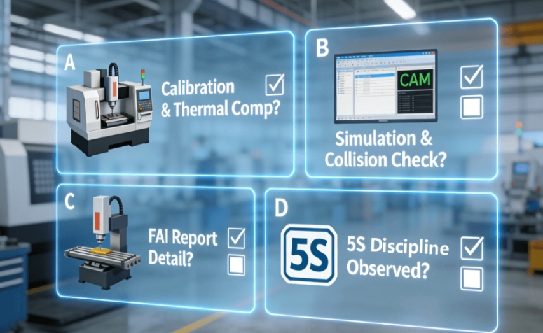
Think outside the box when on the shop floor, don’t just count the machines during a shop tour. A well thought-out evaluation of a potential partner should be based on the makeup of their equipment, the capabilities they have exhibited, and the ways they maintain and use technology to ensure the quality of parts. Don’t inquire, “How many 5-axis machines do you have? ” Instead, say “Can you show me your most recent reports on the calibration of position accuracy and repeatability for this type of machine? ” or “What is your thermal compensation method for this type of spindle during long finishing operations?”
1. Scrutinizing Calibration, Maintenance, and In-Process Control
Ask to see proof, not simply to hear claims. Ask to see the machines’ calibration stickers to ensure the dates are current. Ask about the machines’ preventive maintenance schedule. An important point of differentiation comes in the form of in-machine probing and on-the-fly measurement. Does the machine have a high-precision touch probe? Is it being used simply to set up workpieces or to perform in-process control and automatically compensate for tool wear? This capability represents a direct path to attaining and sustaining the tight tolerances necessary to become a Precision Engineering company.
2. Understanding Machine Configuration and Its Impact
The machine type of 5-axis, like a trunnion table or a tilting spindle, will determine the advantages. A trunnion machine might be more rigid for smaller parts, while a tilting head machine could be better for bigger parts. During the 5-Axis CNC Machining tour, did you observe the machines working? Is the chosen machine setup in line with the parts being made? Is the machine running smoothly, with very few vibrations? One’s knowledge of 5-Axis CNC Machining can be greatly increased by checking out resources that start with the basics and then cover even the more complex aspects. This way, one’s observations will be more meaningful.
3. Assessing the Ecosystem Around the Machine
Finally, we have the support system. Examine the preset equipment and support system. Are the cutting tools organized, identified, and in good working order? Examine the workholding equipment being used. Is it customized, precision-designed equipment, or are vises being employed? The support equipment and tooling are as important as the machine itself. They are the direct interface to your component part. An operation that has invested in quality support equipment has also invested in a philosophy of total quality, ensuring that the accuracy potential of the machine is maximized in the finished product.
From CAD to Finished Part: How to Evaluate the Invisible “Digital Thread” and Programming Expertise?
The biggest difference between your supplier and the competition may not be visible at all; it may be invisible and reside in the “digital world” of software and programming strategies. A factory tour is your chance to audit this key “digital thread.” Look around the engineering area and notice the computer-aided manufacturing (CAM) software that is being utilized (Siemens NX, HyperMILL, Mastercam, etc.). More important than the software being utilized is the conversation that the programming staff is having about programming strategies such as “trochoidal milling” for roughing operations or “smooth tool axis movement” for finishing complex surfaces.
- Validating the Simulation and Verification Process: One of the red flags is if there is no simulation. A program should be simulated in virtual CAM software before it is allowed to go to the shop floor. Ask to see a simulation of a similar part to yours. Does it include complete machine tool collision detection (in other words, does it examine the possibility of crashes between toolholder, spindle, and workpiece)? A solid simulation and verification procedure is a must, and it serves as a protection against disastrous, time-consuming crashes and expensive scrap, which are typical of a mature, risk-averse manufacturing process.
- Gauging Engineering Collaboration and Problem-Solving: Pay attention to how the engineering team talks to each other. Do they explain the “why” behind their tool path decisions when discussing a difficult feature? Do they think about chip evacuation, thermal management, and residual stresses? That level of thinking means they are not just CNC programmers, but actual manufacturing engineers. The ability to interpret intricate design concepts into a solid, optimized machining process is what separates a quality 5-axis CNC machining parts manufacturer from a mediocre one. That means your design not only gets made, but made well, efficiently, and reliably.
- Ensuring a Seamless Digital Handoff: The digital thread also includes project management. You might ask them about their process for managing ECOs and design changes. Do they have a process in place to ensure that the latest revision is always in production? Do they have a digital project portal for sharing drawings, inspection reports, etc.? A seamless and transparent digital process prevents communication errors and keeps your project on track. This is a significant portion of their overall production solutions.
The Quality Cornerstone: Which Certifications and In-Process Checks Truly Guarantee Dimensional Perfection?
Quality certifications are the promise. The shop floor is the place where that promise is fulfilled. Your plant tour needs to confirm that these quality certifications, such as ISO 9001, IATF 16949, or AS9100D, are not just “hung on the wall in the lobby.” You must ask more than, “Are you certified?” You need to ask, “How does the certification mandate manifest in your day-to-day operations?” If you are ordering a part that requires PPAP as specified in IATF 16949, ask to see an example of a recent PPAP package.
1. Auditing the Inspection Arsenal and Its Use
Modern metrology’s availability and usage are quite telling. A trustworthy Precision 5-Axis CNC Machining company should be equipped with Coordinate Measuring Machines, optical comparators, and surface roughness testers, among other devices, all located on the premises. Notice during the tour whether these pieces of equipment are being used for First Article Inspections (FAI) and in-process checks or if they are just left unused in a corner. Ask to see a sample FAI report. It should be a very detailed report that compares the actual measured data to the drawings, not just a simple approval stamp.
2. Connecting Standards to Specific Control Activities
Connect international standards with real-life actions. For instance, the ASME Y14. 5 standard defines the terms for the language of geometric dimensioning and tolerancing. Ask the quality manager the following question, “How do you verify a composite profile tolerance callout per ASME Y14. 5 on a complex contoured part? ” A quality manager’s answer to this question will show whether they are familiar with the exact terminology that describes the functional requirements of your part.
3. Assessing Cultural Commitment to Quality
Quality, at last, is a culture. Observe the relationship between operators and inspectors. Is there a mutual commitment to defect prevention or a relationship focused on finding defects? Are non-conforming materials clearly identified and separated? A culture in which all members are committed to quality is far more important than any audit. This cultural commitment to quality, as demonstrated through daily behavior and attitude, is the final assurance of quality and an important part of a comprehensive Supplier Evaluation.
Translating Observations into Value: The Way an Educated Tour Could Lead to a More Precise and Compete Quote?
The information gleaned from a successful factory tour should translate into the business conversation and enable you to break down the quote and understand the true cost of the services and opportunities for co-value creation. As you review the quote from the supplier after the tour, you can correlate the services with the supplier’s capabilities. The “engineering and programming” expense is not just a fee; it’s the cost of the sophisticated CAM strategies and simulations that eliminate errors and save money. The “quality assurance” expense is the cost of the sophisticated CMM and rigorous FAI process that was demonstrated to you.
1. Negotiating Based on Verified Efficiency and Risk Mitigation
You can talk about your observations regarding the concept of total cost of ownership (TCO). You may say, “I saw your in-process probing and tool management system, which should result in higher first-pass yield and reduced scrap. How does that efficiency factor into pricing for production quantities?” or “Your approach to 5S and maintenance looks to be reducing the likelihood of unexpected downtime that could impact my timely delivery. How can we work out a pricing structure that reflects the benefit of that?” This approach focuses on the value of efficiency and reduced risks rather than price negotiation.
2. Co-Creating a Transparent and Aligned Quote
An educated buyer results in an accurate quote. Knowing the real constraints and abilities of the supplier, you can provide more accurate requirements for the supplier’s benefit. This way, the supplier can provide a quote that’s more favorable to them without compromising on critical specifications. The idea here is to create a quote for a 5-axis CNC machining service that’s transparent and equitable to both parties, reflecting the actual value exchanged in the partnership.
3. Securing a Foundation for Long-Term Partnership
So, the ultimate value of the tour is strategic. It provides a foundation for a partnership that is built upon transparency, understanding, and shared goals. You’re not simply purchasing parts. You’re investing in a supplier’s ecosystem. And the tour enables you to determine whether that ecosystem has sufficient foundation to support your future growth, handle the intricacies of your designs, and accommodate your changing needs. Choosing a partner that has passed this thorough, observational selection process is the best way to realize cost reduction, business resiliency, and project success in custom fabrication.
Conclusion
The process of finding a 5-axis CNC machining partner is, at its core, a process of finding a long-term relationship. A carefully planned, insight-driven factory tour represents the ultimate tool to cut through marketing hype and assess a supplier’s true ability. This process enables a buyer to scrutinize, firsthand, all of those factors which drive quality, cost, and delivery. By elevating this process from a courtesy to a requirement within a buyer’s procurement process, a buyer can take a strategic step to de-risk a project, ensure success, and reap the substantial cost benefits available from a capable, transparent, and trusted manufacturing partner.
H2: FAQs
Q1: We are a startup with limited funds. Is it acceptable to ask for a factory tour?
A: Yes, it is perfectly fine. A quality supplier will acknowledge your request as a sign of your seriousness as a client, no matter the size of your company. Your request should be presented as a technical review of their capabilities, particularly relevant to your project. A supplier with a healthy ego will interpret your request as a testament to your dedication to your project. For startups, it is even more important to conduct due diligence to prevent costly mistakes, and the factory tour is certainly worth the investment.
Q2: What are the top 3 things I should ask the quality manager during the factory tour?
A: First, ask to see their recent non-conformance report and how it was resolved. Second, ask them to explain their detailed first article inspection process and what their inspection report looks like. Third, ask them how they ensure consistency in their measurements, both with their equipment and what you might be using.
Q3: How can I evaluate programming skills if I’m not a CAM expert myself?
A: The system and communication aspects can be evaluated. Request a simulation of a toolpath for a similar part to yours. Also, listen for explanations on strategies employed (for example, “We use trochoidal milling here for load management”) and for collision avoidance. A competent team should be able to explain their logic in a way that’s down-to-earth and applicable to the quality of the part, life of the tools, and so on. They’ll be able to demonstrate their expertise without requiring you to be an expert yourself.
Q4: Does a cleaner and more organized factory floor really imply a higher quality of parts?
A: Yes, very much so. A factory that maintains a high level of 5S (Sort, Set, Shine, Standardize, Sustain) is a sign of a well-run operation that has a high degree of systems thinking. A cluttered and messy factory floor, on the other hand, is a sign of a lack of process control and a higher probability of quality issues.
Q5: What’s the most common mistake made when evaluating a CNC machining quote?
A: The most common mistake made when evaluating a CNC machining quote is to look at the price per unit without fully understanding the scope and assumptions made in the quote. The price may be lower and exclude important items such as an inspection report or may be based on an unrealistically high yield. The knowledge gained from the factory tour enables you to “unpack” the quote by asking pertinent questions.
H3: Author Bio
This article is informed by the significant and real-world expertise of precision manufacturing specialists who have undertaken and been involved in countless supplier evaluation processes throughout global supply chains.If you are a procurement or sourcing professional in a critical supplier selection process or seeking a partner that openly invites a high degree of technical evaluation, a structured evaluation process is highly recommended. LS Manufacturing is a certified precision manufacturing partner that works in a completely transparent manner and holds certifications in ISO 9001, IATF 16949, and AS9100D.
