

A creative director at a mid-sized agency recently described a new kind of “production fatigue.” Her team had successfully integrated generative tools into their workflow, slashing the time required to create initial mood boards from three days to four hours. However, by the end of the week, the project was behind schedule. The problem wasn’t the creation of the images; it was the fact that the client was now staring at 150 high-fidelity variations instead of the usual five.
This is the central paradox of modern creative operations. While rendering speed has reached a near-instant state, the human capacity for review, selection, and refinement remains fixed. For operations leads, the goal is no longer just “making things faster.” It is about compressing the feedback loop between a stakeholder’s vague intent and a production-ready file. To achieve this, teams are moving away from brute-force generation and toward structured, multi-model pipelines.
The Production Paradox: When Speed Creates a Bottleneck
In a traditional pipeline, the bottleneck is almost always technical or labor-bound. High-end retouching, complex 3D renders, or frame-by-frame video editing take a predictable amount of time. Because these tasks are expensive and slow, teams are forced to be disciplined during the briefing phase. You don’t ask for fifty versions of a hero image when each one costs $2,000 in billable hours.
Generative AI flips this. Tools like Banana AI Image have effectively commoditized the first draft. When the cost of an iteration drops to near zero, the natural instinct is to over-produce. This creates a “1-to-many” ratio that can paralyze a creative lead.
Velocity, in a professional context, should not be measured by images per minute. It must be measured by “approved assets per week.” If a tool generates 1,000 images but requires a senior designer to spend six hours sorting through them to find one that doesn’t have “hallucinated” geometry or brand-inconsistent lighting, the net gain is negligible. The operational challenge is shifting the focus from generation to curation and refinement.
Measuring Velocity Shifts in the Ideation Phase
The ideation phase is where the most visible gains occur. Historically, concepting required “scraping”—searching stock libraries for “close enough” images to convey a mood. This is inherently limited by what has already been photographed.
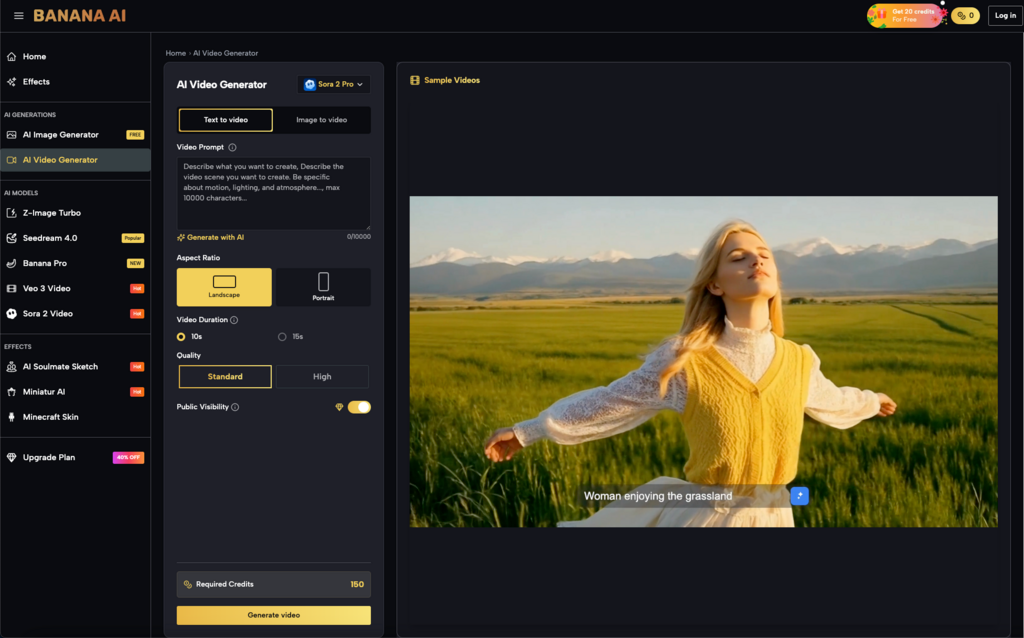
By utilizing Banana AI, creators can bypass the limitations of stock libraries. For instance, using models like Seedream 4.0 or Banana Pro allows a team to visualize a specific prompt—say, “brutalist architecture in a neon-drenched desert with matte-finish textures”—without needing to find a photographer who has already shot it.
The “hallucination tax” is a real factor here. While early generative models often required dozens of prompts to get a coherent result, newer iterations have improved the “prompt-to-accuracy” ratio. This reduces the time spent on “prompt engineering” and moves the team closer to a 48-hour mood-boarding cycle being compressed into a single afternoon session. However, a significant moment of uncertainty remains: even the best models currently struggle with precise color-space accuracy (like matching a specific CMYK or Pantone value directly from a prompt), meaning manual color grading in post-production is still an essential, non-automated step.
Image-to-Image Workflows and the End of the ‘Re-Start’ Culture
The most significant drain on creative velocity is the “re-start.” In many basic AI workflows, if a stakeholder wants a minor change—moving a light source or changing a character’s expression—the creator is forced to generate a completely new set of images from a revised prompt. This often results in losing the qualities that the stakeholder liked in the first place.
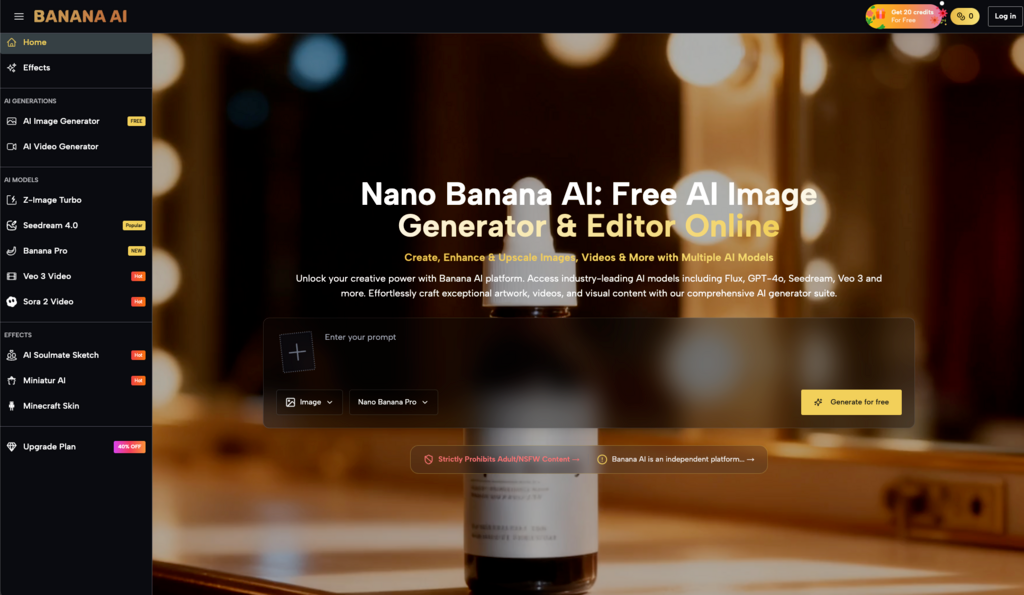
Professional operations leads are now prioritizing image-to-image workflows. Instead of starting from zero, they use the initial Banana AI Image output as a foundational layer. By adjusting “strength” sliders or using specialized models like Z-Image Turbo for rapid iteration, they can maintain visual consistency across a campaign.
This granular control is what allows a creative team to cut review cycles. If you can show a client that you’ve kept 90% of the image they liked and only changed the requested 10%, the “trust gap” closes. Without this capability, the review process becomes a game of “guess the prompt,” which is a recipe for project creep.
Delivery Integrity: Upscaling and Format Constraints
A major limitation often ignored in “AI for marketing” hype is the gap between a 1024×1024 preview and a production-ready file. Most generative outputs are, by default, insufficient for high-end print or 4K video displays.
In a professional creative ops environment, the “generation” is only the first 20% of the work. The remaining 80% involves:
- Upscaling: Moving from a web-optimized resolution to a file that can handle 300 DPI print requirements.
- Detail Enhancement: Fixing the “AI plastic” look that can plague certain models by re-introducing grain or texture.
- Format Flexibility: Ensuring the aspect ratio (whether 16:9 for YouTube or 9:16 for TikTok) is native to the composition, rather than just cropped.
Choosing the right model for the job is a logistical decision. For example, a team might use the Veo 3 Video model for rapid prototyping of a social ad, but they must recognize the current limitation: video consistency over long durations (more than 10-15 seconds) is still a significant technical hurdle. We are not yet at the point where a single prompt can reliably generate a 30-second commercial with perfect continuity between the first and last frame. Expecting the tool to do this leads to failed deliveries and missed deadlines.
The Strategic Boundary: What Automation Cannot Solve
Despite the massive gains in production velocity, there are boundaries where human judgment remains the only viable tool.
Brand-Specific Nuance
While Banana AI can generate stunning visuals, it does not inherently “know” the visual shorthand of a specific luxury brand versus a mass-market retail brand. The subtle difference in “expensive-looking” lighting versus “accessible” lighting is a human-led decision. If a creative lead abdicates this responsibility to the model, the brand identity begins to dilute into a generic “AI aesthetic.”
The Uncanny Valley and Performance Marketing
There is a persistent uncertainty in performance marketing regarding how “perfect” an image should be. Data occasionally shows that slightly flawed, human-shot photography can outperform hyper-polished AI imagery in terms of click-through rates. The “uncanny valley” effect—where an image looks almost real but feels “off”—can trigger a subconscious distrust in consumers. Professional teams must constantly evaluate whether the speed of Banana AI Image generation is being traded for a loss in authentic human connection.
Typography and Precision Layout
While models are improving at text rendering, they are not yet replacements for a layout designer. The precise tracking and kerning of a headline, or the placement of a logo within a safe zone, still require a manual hand in software like Illustrator or Figma. Attempting to force the AI to handle the final typography often results in more time spent “fixing” the text than it would have taken to just typeset it manually from the start.
The New Definition of Velocity
The shift from manual production to AI-assisted workflows is not a simple “fast-forward” button. It is a fundamental reorganization of the creative department. The role of the “maker” is shifting toward that of a “director,” and the role of the “director” is shifting toward that of a “curator.”
By using tools like Banana AI to handle the heavy lifting of initial visualization and iterative variations, teams can spend more time on the final 10%—the 10% that actually makes the work effective. The gains in velocity are real, but they are only “hard gains” if the review process is managed with as much technical rigor as the production itself. The bottleneck has moved; the successful creative operations lead is the one who knows how to unblock it.





Leave a Reply